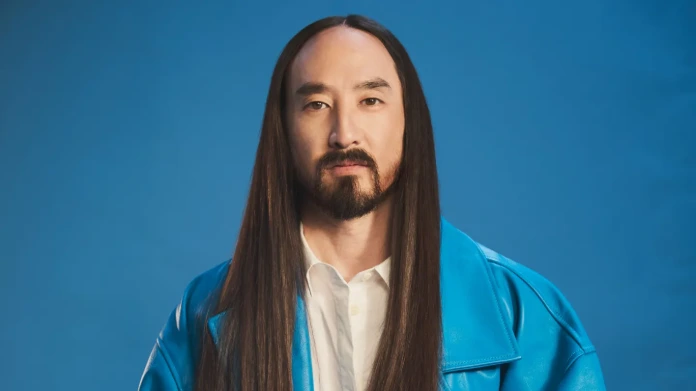
Few artists have transformed the idea of what an electronic music performer can be quite like Steve Aoki.
For some listeners, he is the DJ throwing cakes into crowds, sprinting across festival stages and turning every set into a spectacle. For others, he is the founder of Dim Mak, the independent label that helped launch and support artists across punk, indie rock, electro, EDM and beyond. He is also a producer who has moved between dance music, hip-hop, rock, Latin music and K-pop with almost no interest in respecting genre boundaries.
Reducing Steve Aoki to one of those identities would miss the point. His career has always been built around combining them.
Long before he became one of the most recognisable faces in global EDM, Aoki was organising shows, building communities and releasing records from the margins of American music culture. Dim Mak began in 1996 while he was still a student, and the label has since developed into an independent music, events and lifestyle brand with a history spanning three decades.
That early experience shaped everything that followed. Aoki did not enter electronic music only as a producer looking for personal success. He arrived with the mentality of a promoter, label founder and scene-builder, someone who understood that music becomes more powerful when it creates a world around itself.
Thirty years after Dim Mak began, that philosophy remains central to his career. In 2026, the label celebrated its anniversary with a dedicated Tomorrowland stage featuring artists from different generations of its history, while Aoki marked the occasion with a surprise back-to-back performance alongside Reinier Zonneveld.
The moment captured the wider story of Steve Aoki: an artist rooted in independent culture who learned how to make that culture work on the largest stages in the world.
In this post
• The family story behind Steve Aoki
• How punk culture shaped his identity
• The creation of Dim Mak
• From underground organiser to global DJ
• The rise of the Steve Aoki live experience
• Building a career through collaboration
• The importance of Wonderland and Neon Future
• Crossing into pop, rock, Latin music and K-pop
• Why Dim Mak remains central to his legacy
• Thirty years later: Tomorrowland and the future
• Final thoughts
A family story built around risk and reinvention
Steve Aoki’s story begins before electronic music, and in many ways before he was born.
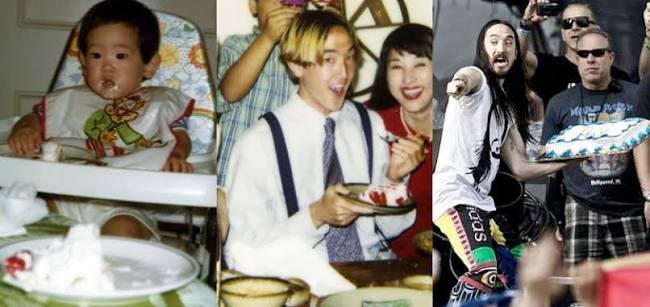
His father, Hiroaki “Rocky” Aoki, moved from Japan to the United States in the early 1960s and eventually founded Benihana, the restaurant chain that introduced a theatrical form of Japanese dining to a broad American audience. Aoki has described how the business initially struggled because customers were unfamiliar with the concept, before a positive review helped turn it into a national success. He has also spoken about visiting his father in Englewood, New Jersey, during his childhood.
That background matters because the Benihana story contains several themes that would later appear in Steve Aoki’s own career: spectacle, cultural translation, risk-taking and the understanding that presentation can be as important as the product itself.
Rocky Aoki did not simply sell food. He helped turn the act of eating into entertainment for an American audience. Steve would later take a similar instinct into music, transforming the DJ set from a person standing behind equipment into a form of physical theatre.
The parallel should not be exaggerated, but it is difficult to ignore.
Both careers were built around taking an existing format and asking how it could become more immediate, visual and communal. In Steve Aoki’s case, that eventually meant inflatable rafts, champagne, relentless movement and the famous cakes thrown into willing sections of the audience.
However, the polished global entertainer came much later. Before the enormous stages, Aoki’s identity was shaped by a very different culture.
Punk before EDM
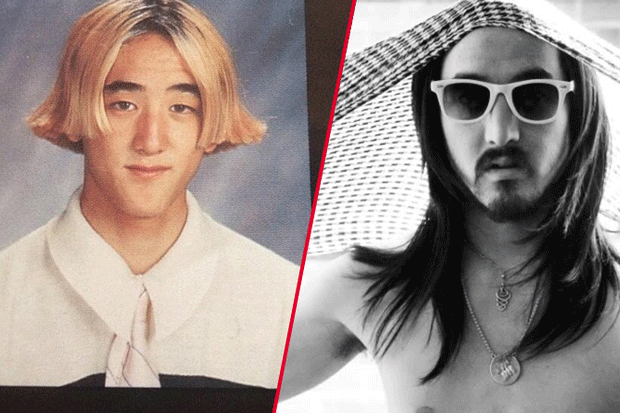
Aoki’s path into music did not begin with a fascination for celebrity DJs or nightclub luxury. It began in punk and hardcore, environments built around small venues, self-organised shows and the belief that people did not need permission from major institutions to create something meaningful.
While studying at the University of California, Santa Barbara, he became involved in the local music community and started organising concerts. During that period, at the age of 19, he founded Dim Mak. UCSB later described him as one of its best-known alumni and noted that the label began during his student years before growing across music, events and fashion.
The importance of this phase goes beyond biography.
Punk culture taught Aoki how to think independently. It showed him that a living room, a temporary venue or a small collective could become culturally important if the energy was strong enough. It also gave him the instinct to support artists before the wider industry had decided they were valuable.
That do-it-yourself mentality became the foundation of Dim Mak.
Even as the label later entered electronic music and the scale of Aoki’s career expanded, the original idea remained surprisingly consistent: find artists with a clear identity, create a platform around them and build a community before waiting for mainstream approval.
This is why Aoki’s rise feels different from that of many DJs who emerged during the EDM explosion. He did not begin by trying to become a festival headliner.
He began by trying to create a scene.
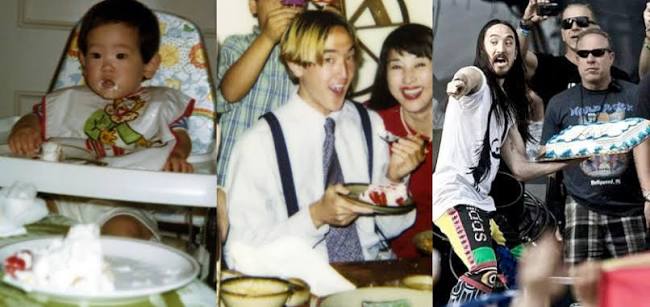
Dim Mak was never just a label
Founded in 1996, Dim Mak developed from a small independent project into a Los Angeles-based label, events company and lifestyle brand. Its official identity still presents it as an organisation built around music, culture and the principle “By Any Means Necessary.”
That phrase captures the restless character of both the label and its founder.
Dim Mak has never been defined by one genre. Its history moves through indie rock, punk, electro, house, bass music, hip-hop and festival EDM, reflecting Aoki’s tendency to follow energy rather than strict categories. UCSB’s profile of Aoki credits the label with helping introduce or support acts including The Chainsmokers, The Gossip and The Kills, while building a catalogue that crossed multiple areas of contemporary music.
This diversity was not accidental.
Aoki understood early that scenes are rarely as separate as the music industry makes them appear. Punk audiences, indie fans, club crowds and electronic producers may use different language, but they often share the same desire for intensity, identity and community.
Dim Mak became the place where those instincts could meet.
The label also gave Aoki an unusual education. By working behind the scenes, he learned how records are released, how artists are developed, how audiences form and how live culture can turn a song into a movement. When his own DJ career began accelerating, he already understood the infrastructure surrounding success.
He was not simply an artist entering the industry.
He had spent years building part of that industry himself.
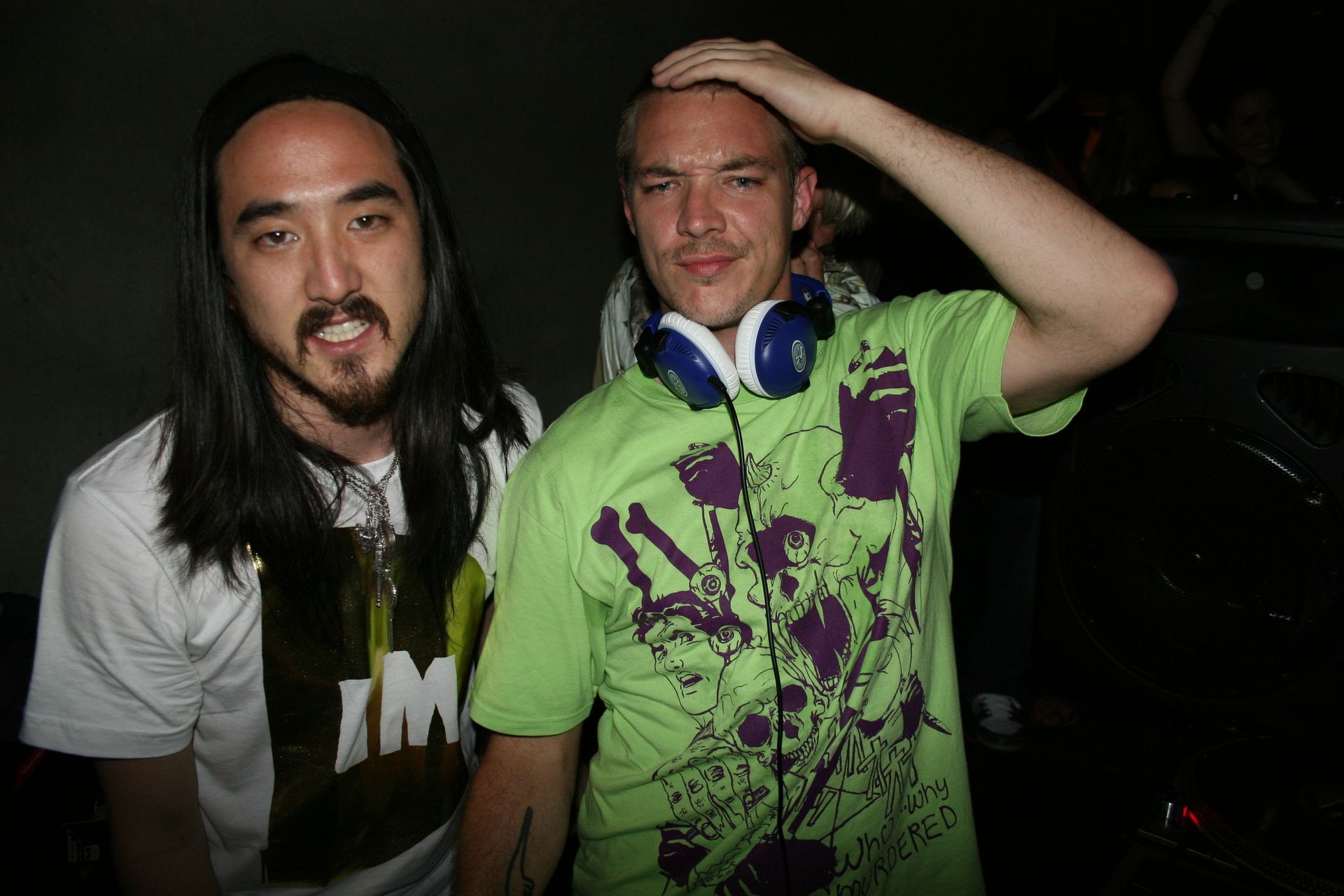
From organiser to performer
Aoki’s transition into DJing happened naturally because he was already immersed in events.
As a promoter and label founder, he understood how rooms behaved. He knew when energy was rising, when audiences became distracted and how a night could be shaped through sequencing rather than one individual performance.
That knowledge became central to his style behind the decks.
Where some DJs present themselves as distant selectors, Aoki developed a much more physical relationship with the crowd. He treated the stage as an extension of the dancefloor, constantly communicating, moving and encouraging participation.
The result was not subtle, and it was never intended to be.
A Steve Aoki performance is built around excess, but the excess serves a clear purpose: to remove the distance between performer and audience. The cakes, rafts and constant movement are not separate from the music. They are part of the same attempt to turn thousands of individuals into one temporary community.
This approach helped him become one of the defining touring artists of the American EDM boom. Historical profiles from the Recording Academy and UCSB describe a schedule that reached hundreds of performances per year and placed him at major festivals around the world.
The intensity of that schedule became part of the Aoki mythology.
His 2016 documentary, I’ll Sleep When I’m Dead, explored the pace, ambition and personal history behind the touring machine. The film later received a Grammy nomination for Best Music Film, adding to the nomination earned by his debut album Wonderland.
The title was not simply clever branding.
It described the way Aoki had built his career: constant motion, relentless expansion and the refusal to treat success as a reason to slow down.
The cake became a symbol, but the crowd was always the real idea
The most famous image associated with Steve Aoki is probably the cake.
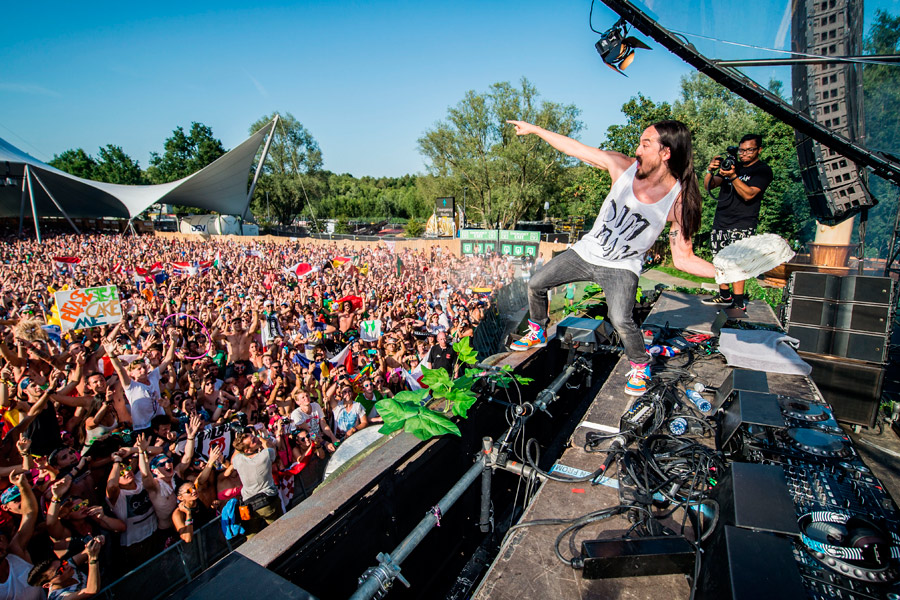
During selected moments in his performances, fans gather with signs asking to be “caked,” turning the act into one of the most recognisable rituals in modern festival culture. To critics, it can appear ridiculous. To fans, it represents the playful chaos that makes his shows distinctive.
Both interpretations are understandable.
What matters is why the ritual survived.
The cake works because the audience is not a passive observer. Fans request it, compete for position and often treat the moment as a badge of participation. The performance becomes something they help create rather than something they simply watch.
That participatory instinct comes directly from Aoki’s background in small, communal scenes.
The scale may have changed dramatically, but the objective is similar: remove formality, destroy the invisible barrier between artist and crowd and make the event feel like something that could not happen in exactly the same way twice.
This is also why his sets have remained effective during changes in electronic music. Big-room sounds, electro house and festival EDM may move in and out of fashion, but collective release does not.
Aoki built his live identity around that release.
The music provides the structure, while the spectacle gives the crowd permission to lose control.
Wonderland and the move from DJ to album artist
By the early 2010s, Aoki had already established himself as a touring force and label founder, but Wonderland marked a new stage in his artistic development.
Released in 2012, the album brought together electronic production with a broad group of vocalists and collaborators. It earned a Grammy nomination for Best Dance/Electronic Album in 2013, placing Aoki alongside artists including Skrillex, deadmau5, Kaskade and The Chemical Brothers.
The nomination gave institutional recognition to a career that had largely been built through touring, independent culture and the rapidly expanding EDM audience.
Aoki later described Wonderland as a learning process that taught him how to think beyond individual singles and build a more cohesive album.
That lesson became especially important for the Neon Future series.
Rather than presenting electronic music only as entertainment, the project explored ideas around technology, science, human development and the possible future of society. The concept allowed Aoki to connect his music with his wider fascination for innovation and longevity.
Not every listener needed to follow the philosophical framework to enjoy the records, but the ambition mattered. It showed that Aoki wanted his albums to exist as more than containers for festival tracks.
The Neon Future era also reflected a central contradiction in his work.
His live shows are immediate and chaotic, yet many of his larger projects are built around long-term thinking: the future of technology, the evolution of culture and the ways people might extend or improve human life.
That combination of instant physical energy and futuristic curiosity is one of the most distinctive parts of his identity.
Collaboration as a creative philosophy
Steve Aoki’s catalogue is crowded with collaborations, but this is not simply the result of commercial strategy.
Collaboration has always been part of how he understands music.
His background as a label founder trained him to listen for what other artists could bring to a project. Instead of protecting one fixed sound, he repeatedly places himself in unfamiliar environments and adapts his production around the person beside him.
That has allowed him to work across an unusually broad range of genres.
His collaborations have connected him with electronic artists, rappers, pop singers, rock bands, Latin stars and K-pop groups. UCSB’s profile highlights work with artists such as BTS, Maluma, Migos, Lil Yachty and Sting, while the Recording Academy has noted his partnership with Linkin Park on “A Light That Never Comes.”
The range is striking, but the pattern is consistent.
Aoki is interested in translation. He asks how the emotional or cultural identity of another artist can survive inside electronic production without becoming completely absorbed by it.
Some collaborations are built for festivals, while others lean toward radio, hip-hop, rock or international pop. The results are not always designed for the same audience, but they all reinforce his position as a connector between musical worlds.
This became especially visible through his work with BTS.
His remix of “MIC Drop” helped introduce a harder electronic and hip-hop edge to an important moment in the group’s international rise, and the track entered the Top 40 of the Billboard Hot 100.
The collaboration also demonstrated Aoki’s ability to recognise cultural movement early. K-pop was becoming a global force, and he approached it not as an exotic novelty but as another serious creative space.
That openness has helped keep his career relevant far beyond the sound of any one EDM era.
Crossing boundaries without abandoning the festival
Many electronic artists face a difficult decision as their careers grow.
They can continue focusing on the dancefloor, or they can move toward pop and risk losing the energy that made them successful. Aoki has spent most of his career refusing that choice.
His catalogue includes highly accessible collaborations, but his live identity remains built around festival intensity. He can work with mainstream vocalists without presenting himself as a conventional pop producer, and he can release harder club records without pretending his enormous audience does not exist.
That flexibility has made him difficult to classify.
He is not an underground DJ in the traditional sense, but his label emerged from independent culture. He is not simply a pop producer, because the physical experience of the rave remains central to his work. He is not only an EDM nostalgia act, because he continues to collaborate with artists from newer scenes.
The tension between those identities is not a weakness.
It is the reason his career has lasted.
Aoki never depended entirely on one genre, one audience or one generation. When electronic music changed, he had enough cultural range to change with it.
The influence of Japanese-American identity
The Billboard cover story presented Aoki as the Asian American cultural figure he had wanted to see while growing up, emphasising how his career acquired meaning beyond music.
That aspect of his story is important because representation in American entertainment has often been narrow, especially for Asian American performers.
Aoki did not fit the traditional image of a global superstar when he began. His success therefore became symbolic for younger artists and fans who had rarely seen someone with a similar background occupying the centre of international festival culture.
He has also carried elements of his family history into the way he presents himself publicly, speaking about his father’s journey, Japanese culture and the pressure of building an identity separate from the Benihana name. His story is not one of rejecting that legacy entirely, but of transforming it.
Where his father built a global business through food and theatrical hospitality, Steve built his world through music, events and spectacle.
Both careers involve cultural exchange, but Steve’s version belongs to a generation shaped by global youth culture, digital platforms and festivals.
His visibility matters because it expands the image of who can lead those spaces.
Dim Mak at 30
In 2026, Dim Mak reached its 30th anniversary, a milestone that makes Aoki’s longevity easier to understand.
The label celebrated across the year through events, touring and special projects. At Tomorrowland, Dim Mak hosted its fifth dedicated festival stage, bringing together artists including Bassjackers, Chocolate Puma, DVBBS, Laidback Luke, Lucas & Steve, Marnik and Quintino.
The lineup reflected the label’s long relationship with electronic music while also showing how Aoki continues to position Dim Mak as a living platform rather than a museum of past achievements.
The most symbolic moment came when Reinier Zonneveld joined Aoki for a surprise back-to-back set and the pair introduced their collaboration “On My Own,” which combined melodic festival emotion with a harder techno influence.
That pairing made sense precisely because it was unexpected.
Aoki represents the maximalist crossover history of EDM, while Zonneveld is associated with a more underground and techno-driven environment. Bringing those worlds together reflects the same instinct that has guided Dim Mak from the beginning.
The label survives because it is willing to move.
Thirty years of history matter, but only if they create space for the next idea.
More than music
Aoki’s interests have expanded far beyond records and touring.
His official website highlights the Aoki Foundation, which supports organisations working in brain science, regenerative medicine and research connected to healthy life extension.
This work fits naturally into the futuristic themes that have appeared throughout his albums and public identity.
For Aoki, technology is not only a production tool. It represents the possibility of changing how people live, age and understand themselves. That curiosity has sometimes placed him closer to futurist culture than to the traditional image of a DJ.
He has also moved through fashion, gaming, digital communities and other areas where music overlaps with lifestyle.
Some artists protect a narrow sense of seriousness by remaining inside one discipline. Aoki has always done the opposite. He treats music as the centre of a larger creative network, but not necessarily the limit of it.
That approach mirrors Dim Mak itself.
The goal is not only to release songs.
It is to create culture around them.
Why Steve Aoki still matters
Steve Aoki matters because his career shows that spectacle and substance are not always opposites.
The cake throws, inflatable rafts and constant movement are easy to recognise, which sometimes causes people to underestimate the infrastructure beneath them. Yet behind the performance is a label founder who has spent three decades developing artists, organising events and connecting musical scenes.
His success did not begin with a viral stage ritual.
It began with community-building.
That foundation explains why his career survived beyond the original American EDM boom. When the dominant festival sound changed, Aoki still had Dim Mak, a global network, a collaborative instinct and an identity strong enough to move into new territory.
He also helped redefine the public image of the DJ.
In earlier club culture, the DJ could function as an almost invisible selector. Aoki became something closer to a frontman, using movement and personality to turn electronic performance into theatre.
That model has influenced an entire generation of artists who understand that festival audiences often connect with character as much as technical ability.
Whether someone loves or dislikes his style, the influence is difficult to deny.
Aoki helped make the DJ visible.
Final thoughts
Steve Aoki’s story is not simply the story of a famous DJ.
It is the story of someone who learned to create culture before he learned to dominate a main stage.
The early punk shows, the founding of Dim Mak and the years spent building independent communities gave him a perspective that many artists only develop after success. He understood that music needs more than songs. It needs spaces, symbols, shared rituals and people willing to believe they belong to something together.
When electronic music entered its period of global expansion, Aoki was prepared.
He brought the energy of small, chaotic rooms into arenas and festivals, replacing physical proximity with spectacle but preserving the same desire for collective release. His shows became louder, brighter and larger, yet the central idea remained communal.
Dim Mak gave him credibility as a builder. Wonderland and the Neon Future projects gave him a broader artistic identity. His collaborations allowed him to move between cultures and genres, while his Japanese-American background gave his visibility a significance that extended beyond dance music.
Now, with Dim Mak celebrating thirty years and continuing to host stages at festivals such as Tomorrowland, Aoki’s legacy feels increasingly clear.
He did not build the most restrained career in electronic music, and he never tried to.
He built one of the most recognisable.
More importantly, he built an ecosystem that could survive changes in sound, technology and audience taste.
The cakes may be the image people remember, but the deeper achievement is everything around them: the label, the community, the collaborations and the belief that music should never remain trapped inside one scene.
Steve Aoki turned chaos into identity.
Then he turned that identity into a global movement.
If you made it this far, thank you for reading.
Have a good music day.