For decades, the soundtrack of Formula 1 seemed obvious: engines screaming down a straight, radio messages from the pit wall and the roar of thousands of fans when the lights went out. Music existed around the sport, but it was rarely considered an essential part of the experience.
That has changed dramatically.
Modern Formula 1 weekends increasingly resemble a combination of elite motorsport, global entertainment and music festival, with DJs performing beside the circuit, international artists taking over stages before and after races and carefully curated playlists extending the atmosphere far beyond the track itself. From Tiësto and David Guetta to Bad Bunny, Taylor Swift and Peggy Gou, the relationship between racing and music has moved from occasional crossover to something much more deliberate.
Formula 1 has increasingly positioned itself not simply as a racing championship but as a wider entertainment brand, and music has become one of the most effective ways of reaching audiences who may discover the sport through culture before they ever become interested in lap times or tyre strategies. The launch of the official F1 Tracks playlist in 2019 was an early sign of that evolution, while today's Grand Prix weekends can feature concerts, DJ sets, artist collaborations and performances directly on the starting grid.
The result is a relationship that feels increasingly natural: speed gives music an image, while music gives racing an emotion that continues long after the chequered flag.
In this article:
- How music became part of the modern Formula 1 experience
- The birth of F1 Tracks and the official Formula 1 playlist
- Why Grand Prix weekends increasingly resemble music festivals
- The special connection between electronic music and motorsport
- From George Harrison to Bad Bunny: F1 inside popular music
- How F1 The Movie pushed the relationship even further
- Grid Gigs and the transformation of the starting grid
- Why playlists matter to Formula 1's new generation of fans
- The future of music and motorsport
- Final Thoughts
The soundtrack now starts long before the lights go out
Attend a modern Grand Prix and the racing is only one part of the weekend.
Fans can arrive several hours before the cars appear on track and find DJ stages, live performances, fan zones and entertainment programmes operating alongside practice sessions, qualifying and the race itself. Once the sporting action finishes, those same venues can transform into concert spaces where thousands of spectators remain at the circuit long after the engines have stopped.
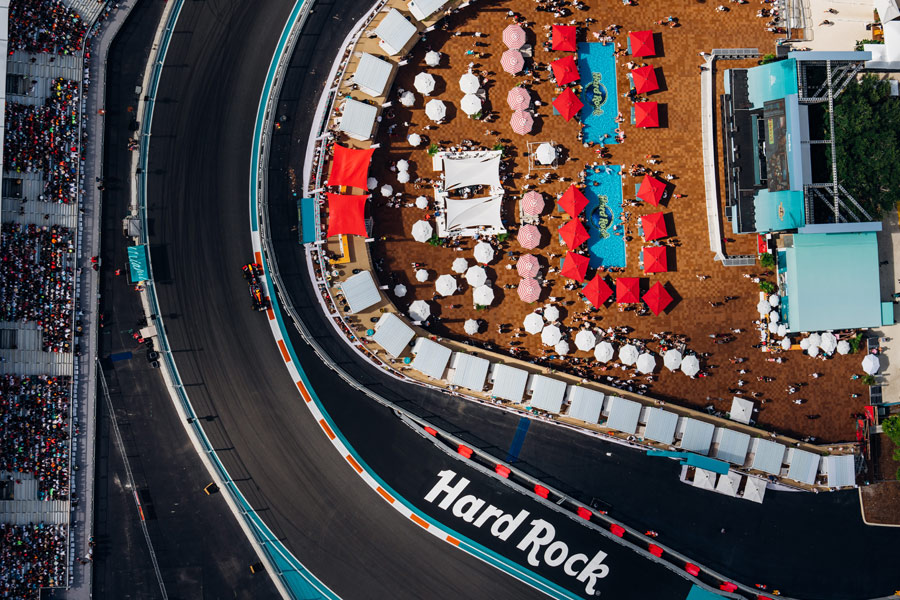
The change is particularly visible at events such as Miami, Las Vegas, Silverstone and Austin, where entertainment has become closely integrated into the identity of the Grand Prix.
At Silverstone, for example, the 2026 British Grand Prix featured four nights of headline entertainment, with David Guetta, Richard Ashcroft, Chase & Status and James Arthur leading a programme that effectively gave race-ticket holders access to a major music festival alongside the Grand Prix.
Las Vegas has pushed the idea even further, using the city's existing nightlife and entertainment infrastructure to surround Formula 1 with performances from major pop, hip-hop and electronic artists. Previous programmes have included names such as Steve Aoki, Kaskade, Zedd, Alesso and SOFI TUKKER, while the 2026 edition will extend the experience beyond the circuit with an official post-race show at the Sphere.
The Grand Prix weekend is therefore no longer designed only around what happens during the race.
Music fills the spaces between the racing.
F1 Tracks: When Formula 1 created its own playlist
Formula 1's relationship with streaming became much more deliberate in 2019, when the championship launched F1 Tracks, its first official music playlist.
Rather than treating the playlist as a random collection of energetic songs, Formula 1 originally built its selection around four concepts: Pace, Mechanical, Spirit and Fan. Tracks were chosen to reflect different elements of the sport, creating a soundtrack that could connect the emotional character of Formula 1 with music outside the circuit.
The idea was simple but effective.
A race lasts only a few hours, while a playlist can remain with fans throughout the week. It can soundtrack the drive to the circuit, the train journey home, a workout or simply the anticipation before Sunday afternoon.
Over time, F1 Tracks expanded beyond its central playlist. Artists including Charlotte de Witte, MEDUZA, AC/DC and Def Leppard have been involved with Formula 1 playlists connected to individual races, allowing completely different genres to interpret the same sporting world. Charlotte de Witte's selection for the Portuguese Grand Prix leaned heavily into high-energy techno, while MEDUZA's Emilia-Romagna playlist even opened with Lucio Dalla's “Ayrton”, connecting electronic music with one of Formula 1's most emotionally significant names.
Today, the official F1 Tracks ecosystem has developed into something broader than background entertainment, including playlists built around individual races and initiatives dedicated to discovering new artists.
In 2026, F1 Tracks: Discovery continued that idea by highlighting emerging talent, demonstrating that Formula 1 can increasingly function not only as a place where established stars perform, but also as a platform through which younger artists can reach a huge international audience.
Why electronic music fits Formula 1 so naturally
Of all the genres that have entered the Formula 1 world, electronic music may be the most natural match.
There is an obvious similarity in energy. Both environments are built around speed, technology, repetition, anticipation and release, while the visual language of modern dance music, LED walls, lasers, industrial design and enormous sound systems, sits comfortably beside one of the most technologically advanced sports in the world.
That connection has become increasingly visible through artists such as Tiësto.
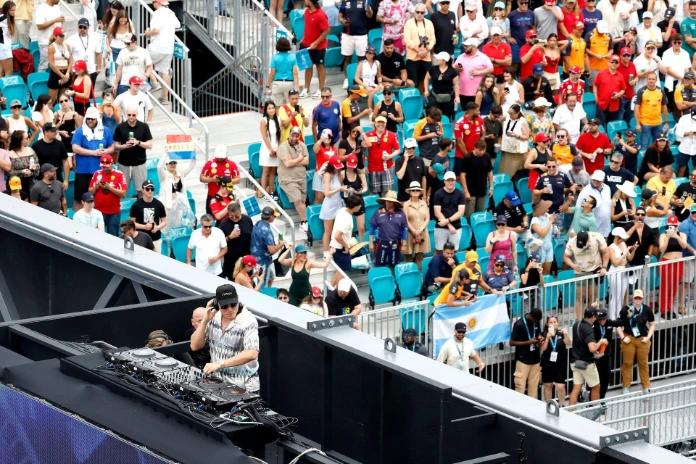
During the 2025 Miami Grand Prix, the Dutch DJ became part of an extensive Formula 1 music takeover, performing around the race itself as F1 promoted the forthcoming soundtrack to F1 The Movie. The wider Miami weekend also featured artists including Kygo, Pitbull, Kaskade, SOFI TUKKER and Cedric Gervais, effectively blending race culture with the atmosphere of a large electronic festival.
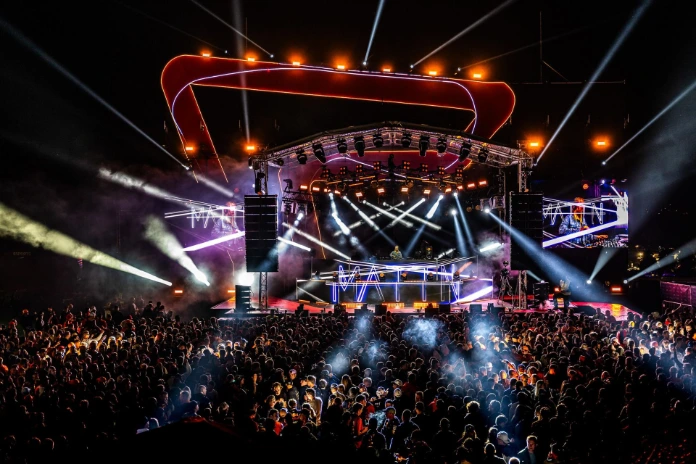
The same pattern appears elsewhere. Afrojack was selected to headline entertainment at the 2026 Dutch Grand Prix, while David Guetta brought his MONOLITH production to Silverstone during the British Grand Prix weekend.
Even outside official race programming, the connection continues to grow. In August 2026, Aston Martin partnered with Defected Records, one of house music's most recognisable labels, for a project explicitly bringing together Formula 1 and club culture.
Electronic music is therefore no longer simply something played at the afterparty.
It has become part of Formula 1's cultural identity.
From George Harrison to Bad Bunny: F1 inside popular music
The relationship between Formula 1 and musicians existed long before streaming platforms and festival-style race weekends.
One of its most famous early examples came from George Harrison, whose fascination with motorsport inspired the 1979 track “Faster”. The former Beatle had become a regular presence around Formula 1 and created the song partly as a tribute to the racing world and the late Ronnie Peterson, even incorporating the sound of Formula 1 engines into the recording.
Two decades later, Robbie Williams turned motorsport history into pop imagery with the video for “Supreme”, portraying fictional driver Bob Williams in a reimagined championship battle with Jackie Stewart.
More recently, however, Formula 1 references have become increasingly embedded within contemporary pop and hip-hop culture.
Bad Bunny has repeatedly referenced the sport in his music, most famously in “MONACO”, where Verstappen and Sergio “Checo” Pérez appear directly in the lyrics. Formula 1 imagery also fits naturally into the track's themes of luxury, speed and international celebrity, demonstrating how the sport itself has become cultural shorthand far beyond motorsport audiences.
Charli XCX referenced Fernando Alonso in “Vroom Vroom”, while Taylor Swift's relationship with Formula 1 culture stretches from lyrical references to her major performance at the 2016 United States Grand Prix, where she played her only concert of that year to around 80,000 spectators.
What once felt like occasional motorsport references now reflects something much wider.
Formula 1 has become part of pop culture's vocabulary.
When the racing world became a movie soundtrack
The release of F1 The Movie pushed that crossover onto an even larger scale.
Rather than relying entirely on existing tracks, F1 The Album was built around original music from a line-up spanning pop, electronic music, hip-hop and country. Artists involved included Ed Sheeran, Tate McRae, ROSÉ, Doja Cat, Don Toliver, Burna Boy, Peggy Gou, Tiësto, Dom Dolla and Chris Stapleton.
The project demonstrated how Formula 1 could provide more than visual inspiration.
Speed, danger, competition and glamour naturally translate into musical themes, giving artists a setting from which to create tracks that can exist independently from the film itself.
More importantly, the soundtrack helped introduce F1 imagery to listeners who may never have actively searched for motorsport content.
A fan could discover Formula 1 through ROSÉ or Tate McRae in exactly the same way another fan might discover a new artist through a race-weekend playlist.
That exchange works in both directions.
Grid Gigs: Turning the starting grid into a stage
Perhaps the clearest example of Formula 1's new approach to music is F1 Grid Gigs.
Introduced in 2025 and expanded in 2026, the concept transforms one of the most recognisable spaces in motorsport, the starting grid itself, into a live performance stage immediately before the race.
The 2026 programme launched in Miami with Manuel Turizo, with Formula 1 announcing plans to bring Grid Gigs to multiple Grands Prix including Miami, Silverstone, Austin, Las Vegas and Abu Dhabi.
The concept has already continued evolving. At the 2026 Italian Grand Prix in Monza, Laura Pausini was selected for a pre-race Grid Gigs performance, with the show made available both to spectators at the circuit and international audiences online.
This is an important shift because music is no longer limited to a stage somewhere outside the circuit.
It is entering the most important moments of the sporting event itself.
The minutes before lights out have traditionally been filled with tension. Drivers prepare, engineers leave the grid and millions of viewers wait for the formation lap.
Adding live music turns that anticipation into entertainment without completely separating it from the race.
The concert does not happen around Formula 1 anymore. It happens inside Formula 1.
Why playlists matter to Formula 1's new audience
The growth of music around Formula 1 also reflects the way the sport's audience has changed.
Fans increasingly experience F1 across social media, fashion, gaming, streaming platforms, documentaries and celebrity culture, rather than only through television coverage on Sunday afternoon. Music fits naturally into that ecosystem because it can travel between all of those spaces.
A song attached to a driver edit on TikTok can become associated with a particular victory. A track playing during a Grand Prix weekend can later bring back memories of the circuit. An official playlist can keep the emotional atmosphere of the race alive several days after the cars have left.
Formula 1 has understood that music creates something statistics cannot, it creates memory.
The 2020 fan-curated F1 Tracks playlist offered a perfect example. When supporters were asked to choose the soundtrack for Formula 1's 70th anniversary, AC/DC's “Back in Black”, Queen's “We Are the Champions” and Sade's “Smooth Operator” emerged among the most popular choices. The last of those had already become closely associated with Carlos Sainz, showing how a song that originally had nothing to do with motorsport can develop an entirely new meaning through fan culture.
This is why Formula 1 playlists are more interesting than simply assembling songs about cars.
The strongest tracks often become connected to racing after fans attach them to a driver, a circuit or a specific moment.
Formula 1 is becoming a music discovery platform
There is another side to the relationship that may become increasingly important.
Formula 1's global audience gives artists access to listeners across dozens of countries within a single season. For major stars, appearing at a Grand Prix reinforces an already established international profile, but for emerging musicians the opportunity can work very differently.
Initiatives such as F1 Tracks: Discovery suggest that Formula 1 increasingly recognises this potential. The 2026 edition was specifically dedicated to championing new and emerging talent and included performances connected with the British Grand Prix.
In that sense, Formula 1 is beginning to operate in a similar way to other cultural platforms.
A racing fan might arrive for qualifying and leave having discovered a new DJ.
A Spotify listener might enter through an F1 playlist and eventually become interested in the championship.
Neither audience needs to begin in the same place, music becomes the bridge between them.
The future of music and motorsport
The relationship between Formula 1 and music is unlikely to become smaller.
The direction is already clear: larger concerts, more artist partnerships, stronger streaming integration and musical programming placed closer to the sporting action itself.
At the same time, collaborations such as Aston Martin and Defected Records suggest that individual teams may increasingly build their own musical identities rather than leaving entertainment entirely to Formula 1 or Grand Prix organisers.
That could create an interesting future in which teams work with labels, artists and DJs in the same way they currently collaborate with fashion brands and designers.
The challenge will be maintaining authenticity.
If every race simply adds a famous artist because entertainment generates attention, music risks becoming another sponsorship asset. The most successful collaborations will instead be those where the artist, location and identity of the Grand Prix genuinely connect.
Miami naturally works with Latin music and electronic culture. Silverstone can combine British music history with global dance acts. Las Vegas already exists as one of the world's largest entertainment destinations.
The strongest race-weekend soundtrack should tell listeners where they are, not simply remind them that a large marketing budget exists.
Final Thoughts
Formula 1 may always be associated first with the sound of an engine, but increasingly that is only one part of its soundtrack.
Over the last few years, music has moved from the background of the Grand Prix weekend into the centre of the experience. Official playlists, artist-curated selections, festival-scale concerts, original movie soundtracks and performances directly on the starting grid have turned Formula 1 into one of the most interesting meeting points between sport and contemporary music culture.
That evolution also explains why the official F1 Tracks playlist feels more significant than a simple collection of songs. It represents the idea that following Formula 1 no longer begins when the lights go out and ends when the podium ceremony finishes.
The atmosphere can start on Spotify days earlier and continue through the afterparty long after the circuit becomes quiet.
Perhaps that is why racing and music work so well together.
Both depend on rhythm, timing, tension and release. Both can turn a few seconds into a memory, and both become considerably more powerful when experienced with thousands of other people, a Formula 1 car may provide the speed.
Music gives that speed a soundtrack.