Some branded campaigns simply advertise.
Others become part of everyday life.
Barilla’s Playlist Timer is one of the smartest examples of how playlist curation can move beyond music discovery and become a real user experience.
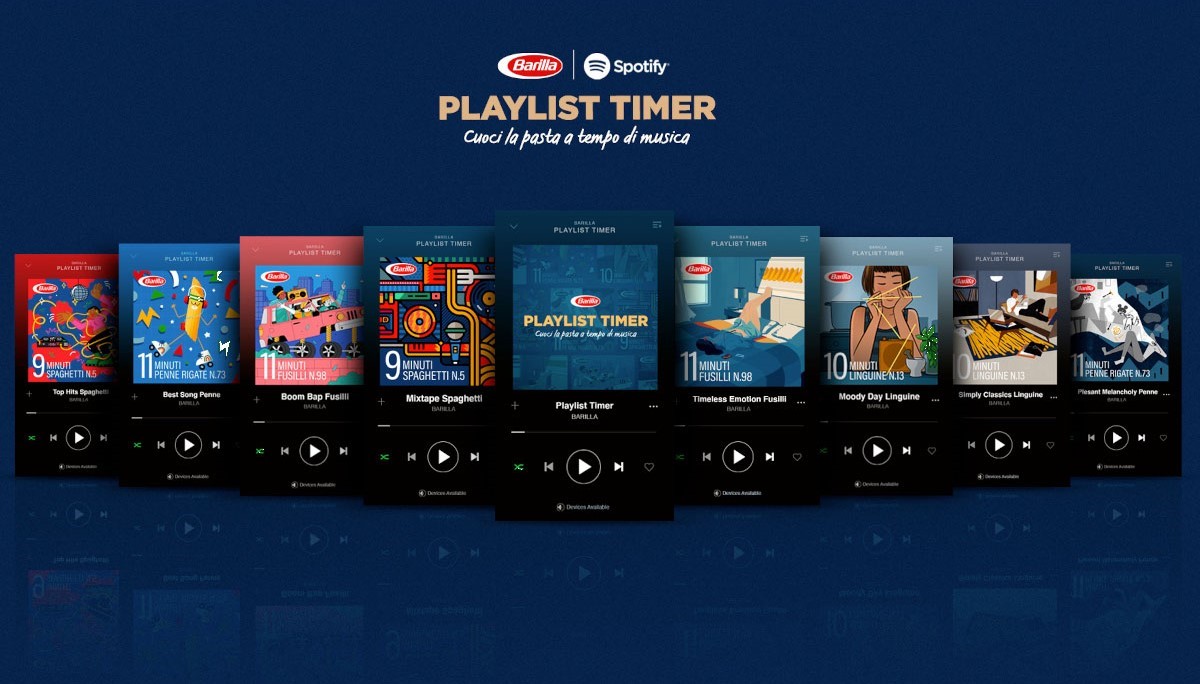
Created in collaboration with Spotify and developed by Publicis Italy, this concept transforms playlists into something far more functional: a perfectly timed soundtrack for cooking pasta.
As a playlist curator, this is fascinating because it redefines what a playlist is supposed to do.
It is no longer just about mood.
It is about utility, timing and behavioral context.
In this post:
• A playlist designed around time, not only taste
• The genius of contextual listening
• The importance of track flow
• Why this works so well for Spotify culture
• Final Conclusion
A playlist designed around time, not only taste
The core idea is brilliant in its simplicity.
Each playlist lasts exactly as long as the cooking time of a specific pasta shape.
Spaghetti, linguine, fusilli and penne each receive their own musical selection, ranging from 9 to 11 minutes, so the music itself becomes the timer.
When the last song ends, the pasta is ready.
From a curation perspective, this is incredibly smart because the sequencing is not random.
The entire playlist architecture is built around duration precision.
This means track order, intro pacing, transitions and final song placement all need to support a fixed time window.
That is a very different curatorial challenge compared to traditional mood playlists.
The genius of contextual listening
What makes this project stand out is its use of context-based curation.
Normally, playlists are built around:
genre
energy
mood
activity
Here, the activity is hyper-specific: cooking pasta.
This places the listener in a clearly defined moment of the day.
As a curator, this is exactly where playlist design becomes powerful.
Music is no longer passive background sound.
It becomes part of the ritual.
The listener is not just pressing play.
They are using music to structure an experience.
This is one of the strongest forms of playlist engagement because it creates habit-driven listening behavior.
The importance of track flow
From a curator’s perspective, the sequencing matters enormously.
A 10-minute playlist cannot afford weak transitions.
Every song needs to contribute to:
smooth pacing
consistent energy
zero skip risk
perfect runtime
This is where great curation lives.
The first track needs to hook immediately, because the listener starts it at the exact moment the pasta hits the water.
The middle section needs to maintain engagement without distracting too much.
The closing track acts almost like a countdown.
Its ending is the signal.
That final silence is the “timer bell”.
This is playlist sequencing used as functional design.
Why this works so well for Spotify culture
This campaign also perfectly fits how people use Spotify today.
Listeners increasingly search for playlists based on activities:
cooking
studying
gym
driving
relaxing
Barilla understood this behavior before many brands did.
Instead of forcing an ad into the platform, they created something native to the ecosystem.
It feels organic.
It feels useful.
And most importantly, it feels like something a real curator could build.
That is why the concept works so well.
It respects platform culture.
Final Conclusion
From a playlist curator standpoint, this is one of the most intelligent branded music concepts ever launched.
It proves that great playlists are not only about selecting tracks.
They are about designing an experience around a listener’s moment.
Barilla didn’t just create branded playlists.
They created functional storytelling through music sequencing.
And that is exactly what great curation should do.
Turn ordinary moments into memorable ones.