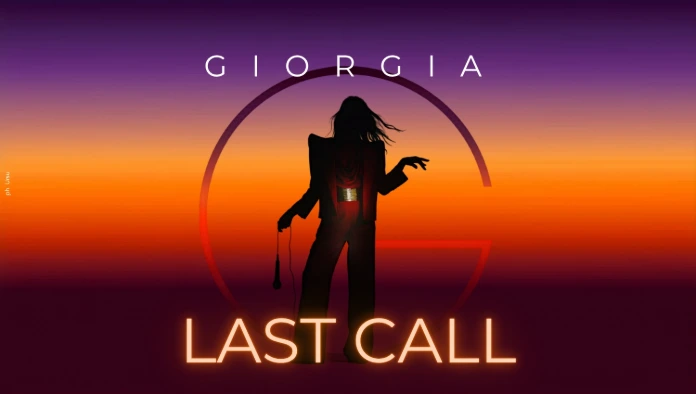
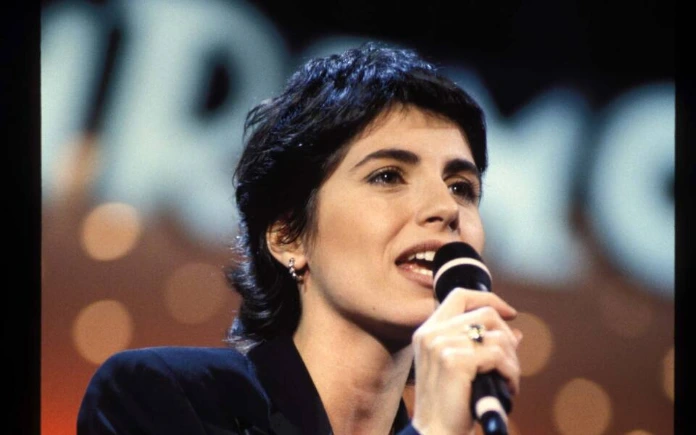

On October 3rd, 2026, Giorgia will bring the journey of “G – Last Call” to an end at Milan’s Unipol Dome, closing what has become one of the most important chapters of her recent career. Rather than feeling like just another final tour date, the show arrives after two remarkable years that have brought one of Italy’s most recognisable voices back to the centre of the conversation, through sold-out arenas, new music and an audience that continues to grow across generations.
There are artists you associate with one particular record, one summer or one very specific period of your life, and then there are those who somehow stay with you long enough to become connected to several different versions of yourself.
Giorgia belongs firmly to the second category.
I have been listening to her since I was six years old, usually in the car with my mother. At the time, she was simply one of those voices I recognised before I really understood what it meant to sing well, to interpret a song or to build a career capable of lasting for more than one generation. Over the years my taste changed, new artists arrived and completely different genres became part of what I listened to, yet some of Giorgia’s songs never really disappeared.
That is what makes the Giorgia of today so interesting. More than thirty years after the beginning of her career, she is not simply a legacy artist taking an established catalogue back on tour. She is experiencing one of the strongest periods of her recent career, supported not only by the songs that made her famous, but by new music that has genuinely connected with a new audience.
“La cura per me” has surpassed 173 million global streams, achieved double-platinum certification and became the second best-selling single in Italy in 2025, while her latest live cycle has resulted in 19 sold-out arena shows and more than 200,000 tickets sold. The album G has given that momentum a wider artistic identity, marking another chapter in what Giorgia herself has described as a genuine rebirth.
On October 3rd, that journey reaches Milan for the final date of “G – Last Call”, officially presented as a special event show. Considering everything that has happened over the last two years, the word “event” feels entirely appropriate.
In this article:
- Who Giorgia Is and How Her Career Began
- More Than Thirty Years Told Through Songs
- The Renaissance of “La cura per me” and the Album G
- From Sold-Out Arenas to G – Last Call
- Why October 3rd in Milan Will Be Different
- A Setlist Spanning Several Generations
- A Band Built Around the Voice
- Why Giorgia Still Connects After More Than Thirty Years
- A Personal Relationship With Her Music
- Everything You Need to Know About the Unipol Dome Show
From Sanremo Giovani to One of the Most Recognisable Voices in Italian Music
Giorgia Todrani was born in Rome on April 26th, 1971, into a family where music was already an important presence. Before the arenas, major television appearances and festival stages, there were clubs in Rome, jazz, soul and years spent developing the vocal technique that would eventually become one of the defining elements of her artistic identity.
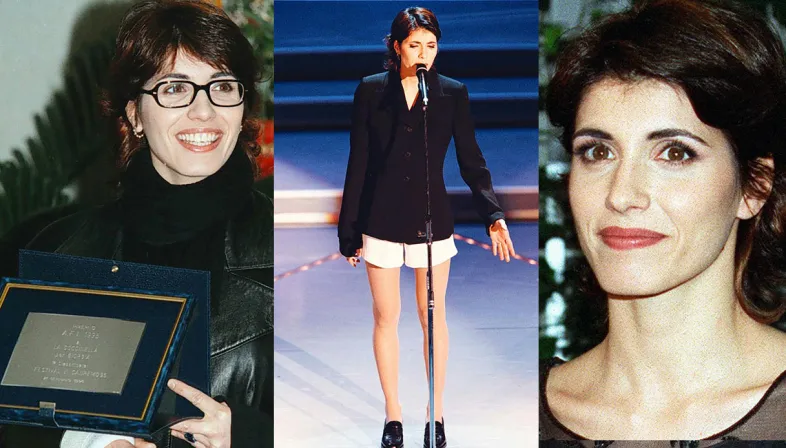
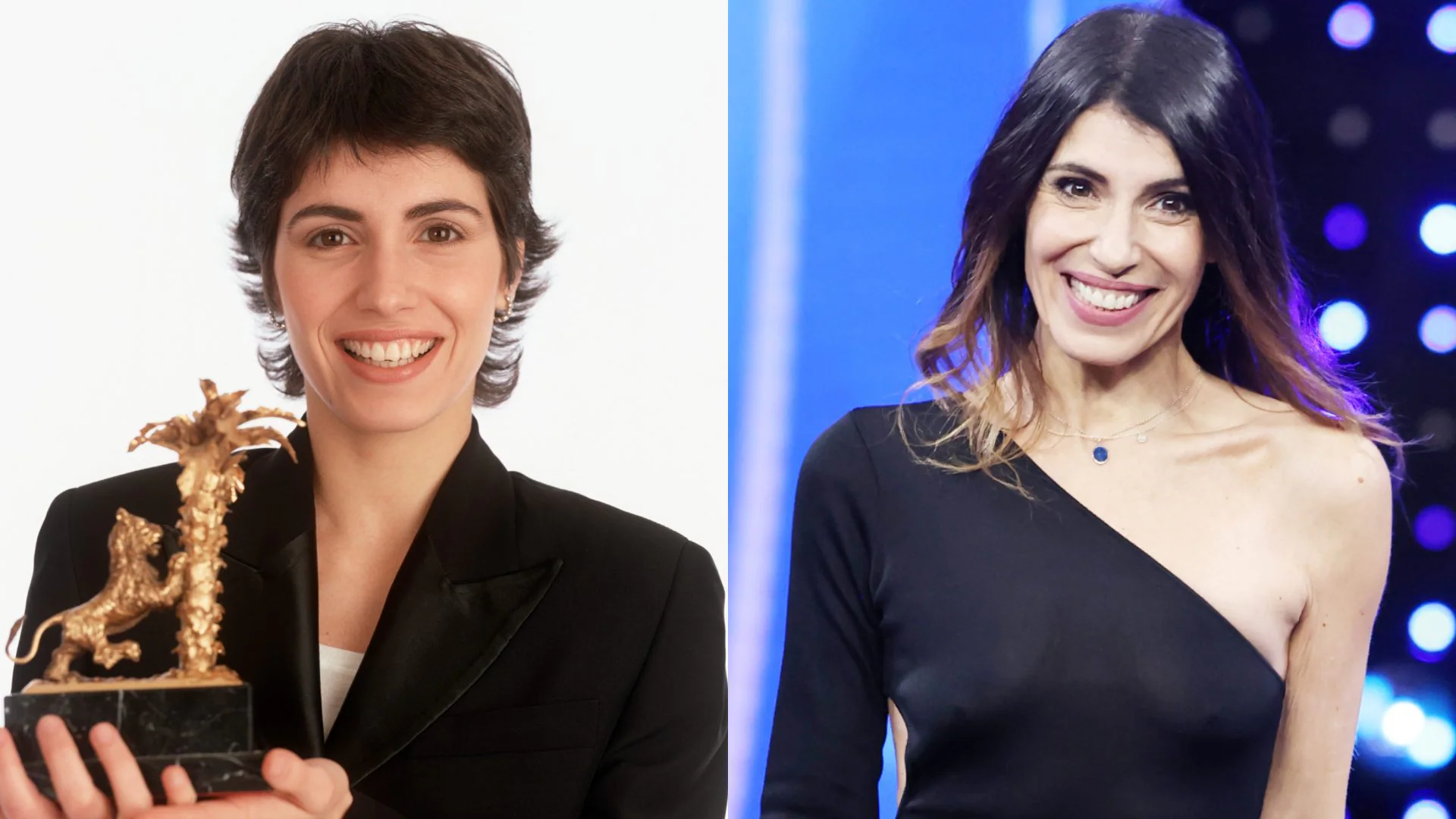
The first major turning point came in 1993, when she won the inaugural edition of Sanremo Giovani with Nasceremo, earning access to the following year’s Festival di Sanremo. In 1994 she performed E poi, but it was 1995 that completely changed the scale of her career, when Come saprei, written with Eros Ramazzotti, Adelio Cogliati and Vladimiro Tosetto, won the Festival as well as the Critics’ Prize.
Giorgia was only 23, yet her voice already carried the control, range and maturity of a much more experienced performer. That early success could easily have defined her permanently, but instead it became the starting point for a career that would move through almost every major phase of Italian pop music over the following three decades.
Songs such as “Strano il mio destino,” “Girasole,” “Di sole e d’azzurro,” “Gocce di memoria,” “Quando una stella muore” and “Oronero” gradually became part of that story, eventually leading to more recent releases such as Parole dette male and the material that defines her current chapter.
Along the way, Giorgia has shared stages and recordings with artists including Luciano Pavarotti, Herbie Hancock, Lionel Richie, Michael McDonald and Ray Charles, with whom she performed Georgia on My Mind at the Lucca Summer Festival in 1999.
What makes her career particularly interesting is that it has never depended on one single period of success. Instead, it has been shaped by different phases, different sounds and different versions of the same artist, each connected by the same unmistakable voice.
The latest phase may be one of the most interesting of all.
A Renaissance Giorgia May Not Have Expected Herself
To understand why the Milan show carries a different weight, it is worth looking at what has happened over the last two years.
Giorgia has spoken openly about a period in which she was no longer certain what kind of space she could still occupy in contemporary music. After more than three decades in the industry, that uncertainty is understandable. The challenge was no longer proving that she could sing; it was understanding whether there was still room for her to say something new without simply repeating what had already worked.
Then came Sanremo 2025.
La cura per me did not win the Festival, but its story quickly became far bigger than the result of a single week in February. The song continued growing month after month, eventually reaching double-platinum certification, remaining near the top of the Italian charts and becoming the second best-selling single of 2025. By March 2026, it had already surpassed 173 million global streams.
Those figures would be impressive for any artist, but they become even more significant when attached to someone whose debut album arrived more than thirty years earlier.
That is what makes this period so remarkable. Giorgia is not currently experiencing a nostalgic celebration of her career; a new part of her catalogue has become almost as relevant to the public as songs they have known for decades.
For an artist with such a long history behind her, that is far from ordinary.
“G” Is Not a Greatest Hits Album Disguised as Something New
In November 2025, Giorgia released “G”, her twelfth studio album, a project that helped turn the success of La cura per me into something broader than a single comeback moment.
The record contains twelve tracks and brings together writers and producers from a musical landscape very different from the one Giorgia first entered in the early Nineties. Names involved in the project include Dardust, Calcutta, Federica Abbate and Tropico, while the album also features a version of La cura per me with Blanco.
What makes the project work is that it never feels like an attempt to artificially make Giorgia younger or force her into a contemporary aesthetic that does not belong to her. Instead, it places a voice shaped by more than thirty years of experience inside modern songwriting and production, allowing that contrast to become part of the record’s identity.
La cura per me is obviously the clearest example, but songs such as “Corpi Celesti,” “Golpe” and “L’Unica” have also helped define a new chapter that does not exist simply in the shadow of Come saprei or Gocce di memoria.
That distinction is important. An artist with a catalogue as strong as Giorgia’s could easily rely on the past, but G works precisely because it does not ask listeners to choose between the old and the new, it allows both to coexist.
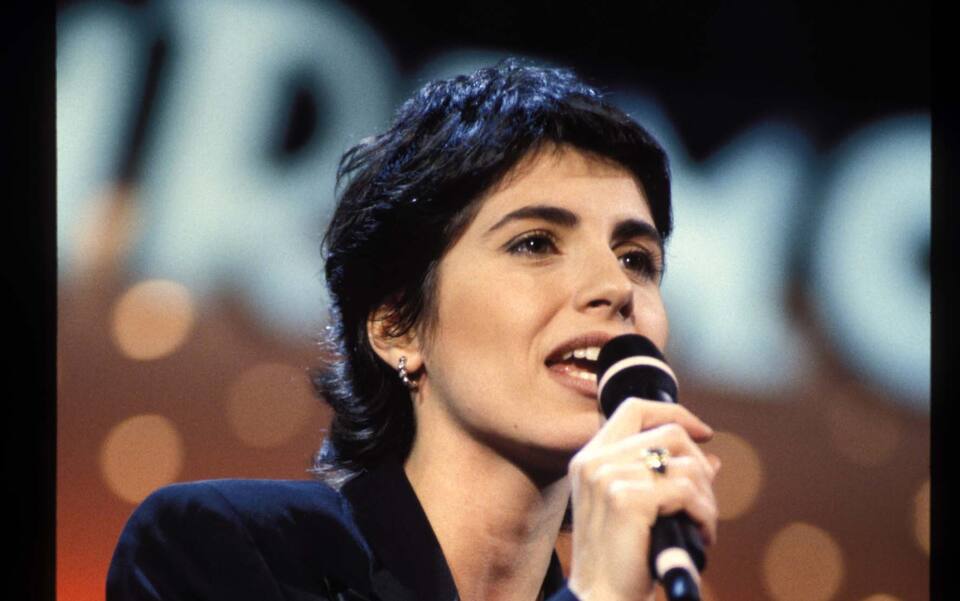
Nineteen Sold-Out Arena Shows and More Than 200,000 Tickets Later, “Last Call” Arrived
The response to Giorgia’s return has been just as powerful on stage as it has been on streaming platforms and radio.
Between 2025 and 2026, she accumulated 19 sold-out arena dates, eventually surpassing 200,000 tickets sold from the previous summer onwards. Rome hosted her several times, as did Milan, before the journey continued through a summer tour that confirmed how strong the demand had become.
At that point, the cycle could easily have ended, instead, Giorgia announced one final chapter: “G – Last Call.”
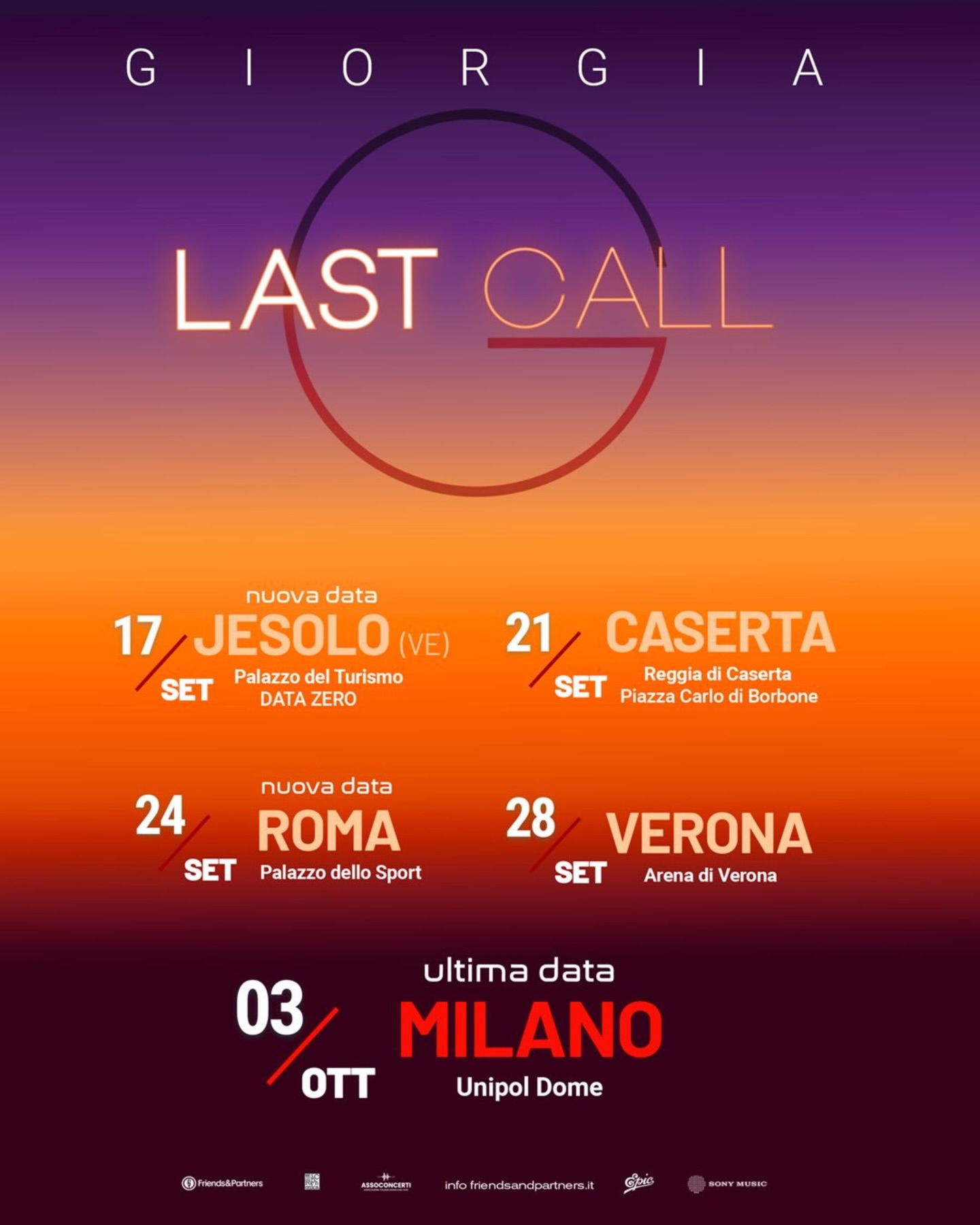
The tour will move through Jesolo on September 17th, the Royal Palace of Caserta on September 21st, Rome on September 24th and the Arena di Verona on September 28th, before reaching its final destination on Saturday, October 3rd at the Unipol Dome in Milan.
The title says a lot about the way these dates have been conceived. This is not the beginning of another long tour, nor a simple extension of what came before. It is designed as the closing celebration of this particular era, bringing together the songs, the success and the people who helped shape it.
Milan Will Be a Special Event, and the Guests Are Part of the Reason Why
The biggest difference between Milan and the other Last Call dates has already been hinted at by the organisers.
At the Unipol Dome, Giorgia is expected to share the stage with several artists who have been part of her musical journey over the last two years, making the final night something more than a standard version of the touring show.
Italian media have repeatedly described the concert as a “serata-evento”, or special event night, and the idea appears to be to use Milan as a final celebration rather than simply another stop on the schedule.
Reports about the exact guest list have not always been identical. Names including Elisa, Annalisa, Eros Ramazzotti and Emma have been mentioned, while other reports have also linked Irama, Blanco, Marracash and Luchè to the night.
Until the full lineup is officially confirmed, it makes more sense to treat some of those names as expectations rather than certainties. What is already clear, however, is that Milan has not been designed as a straightforward repeat of the previous dates.
The atmosphere is likely to be closer to a final gathering around this chapter of Giorgia’s career, bringing together people who have contributed to it both musically and personally, that makes the October 3rd show particularly interesting.
A Setlist Capable of Telling Thirty Years of Music Without Feeling Like a Museum
Then there are the songs, and this is probably where the scale of Giorgia’s career becomes most obvious.
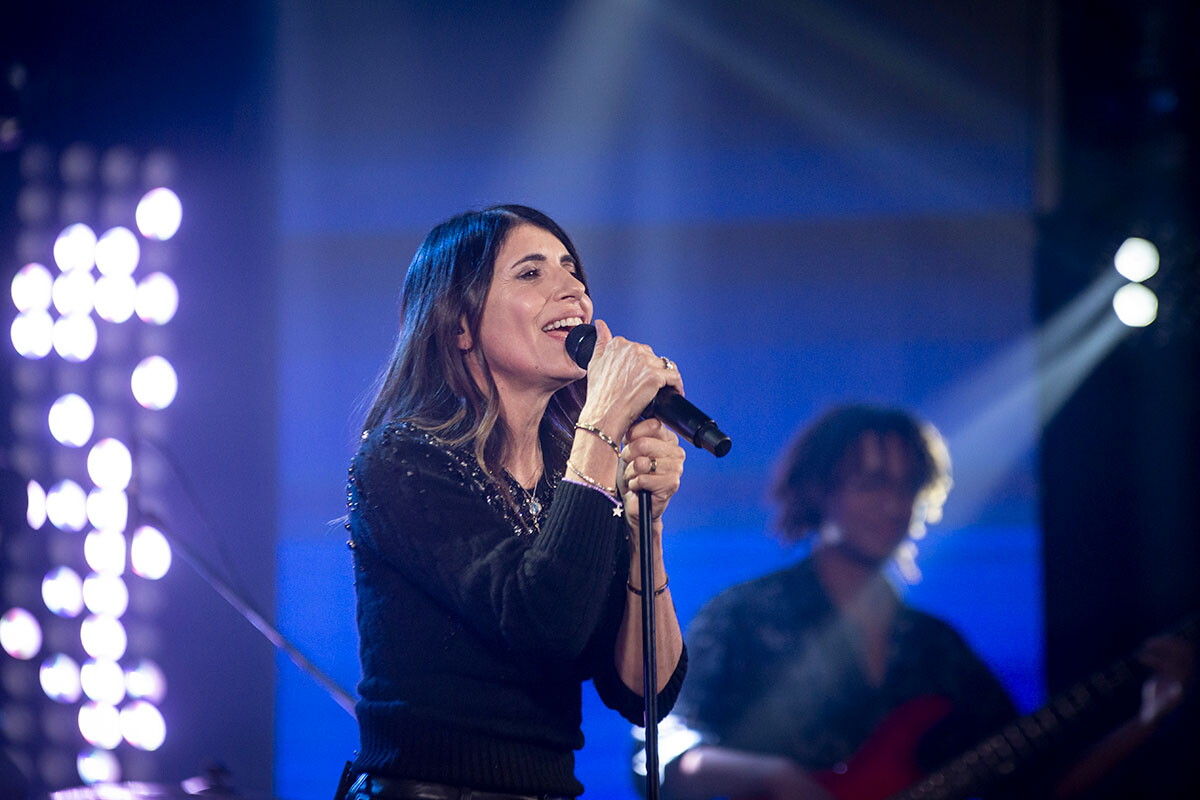
The current show brings together material from “G” with the tracks that have defined very different moments of her career. The new album introduces songs such as La cura per me and Corpi Celesti, while the journey inevitably returns to classics including “Come saprei,” “Di sole e d’azzurro,” “Girasole” and “Gocce di memoria.”
What gives the setlist emotional weight is not simply the fact that these are well-known songs, but the fact that they belong to completely different generations of listeners.
Some people first heard Come saprei on the radio in 1995 and may now be attending the show with their children. Others discovered Giorgia through Gocce di memoria, while another generation arrived later through Oronero or Parole dette male. More recently, an entirely new audience has encountered her through La cura per me.
For one night, all of those experiences are brought into the same room.
That is what allows the show to feel less like a retrospective and more like a live conversation between different moments of the same career.
The Band Matters Almost as Much as the Voice
Reducing a Giorgia concert to the idea that “she has an incredible voice” would be easy, but it would also miss a large part of what makes the live show work.
The current production is supported by an eleven-piece band, including Sonny Thompson on bass and guitar, Mike Scott on guitar, William Mylious Johnson on drums, Gian Luca Ballarin and Fabio Visocchi on keyboards, Diana Frodella and Andrea Faustini on backing vocals, alongside a string section featuring Valentina Sgarbossa, Caterina Coco, Alessio Cavalazzi and Matteo Lipari.
It is a substantial lineup, but one that makes complete sense for Giorgia’s catalogue, because her songs do not all require the same type of arrangement.
Some depend on vocal precision, others on the dynamics of the band, while certain moments are at their most effective when the production almost disappears and only a few instruments remain around the voice.
Those changes in scale are part of what makes the performance feel alive.
The power of Giorgia’s live show does not come only from how high she can sing or how long she can hold a note. It comes from the way she can move between restraint and intensity, using the band around her rather than treating it as simple accompaniment.
That difference becomes far more obvious in person than it ever can on record.
Why Giorgia Still Connects After More Than Thirty Years
The easiest answer would be to say that she can still sing extraordinarily well, and of course that is a huge part of her appeal.
But it does not fully explain why she still feels relevant.
Music history is full of technically exceptional performers who, at some point, stopped communicating with the present. Giorgia has managed to avoid that by changing without pretending to become somebody else.
She has worked in television, returned to Sanremo, collaborated with younger writers and producers and accepted the challenge of placing her voice inside musical environments very different from those that originally made her famous.
Most importantly, she has continued to expose herself to one of the biggest risks facing an artist with such a long career: releasing new music knowing that every new song will inevitably be compared with the classics.
When one of those songs becomes La cura per me, the entire conversation changes.
At 54, Giorgia did not need nostalgia to fill arenas. She found another song that people genuinely wanted to hear, and that says far more about the strength of this chapter than any retrospective celebration could.
Some Songs Do Not Age With You, They Grow With You
There is also another reason why a show like this can feel important, and it has very little to do with statistics.
I have been listening to Giorgia since I was a child, usually in the car with my mother. At the time, Girasole was simply a song I recognised, but years later other tracks began to carry a completely different weight because, in the meantime, I had changed.
That is probably how the relationship with artists who remain present for such a long time works.
The songs stay the same, but we keep returning to them from different places.
You can hear Di sole e d’azzurro when you are ten years old and then hear it again twenty years later. Technically, nothing in the recording has changed, but emotionally it may feel like an entirely different song because your own life has changed around it.
That is why seeing an artist after more than thirty years does not necessarily have to feel nostalgic.
Sometimes it is simply a way of understanding how much of that music has remained with you, and with Giorgia there is a lot to return to.
October 3rd Closes a Circle, Not a Career
A title such as “Last Call” naturally invites people to talk about endings, but it would be misleading to treat the Milan show as a farewell.
The October 3rd concert is the final date of this 2026 live chapter and the conclusion of this specific tour cycle, not an announced goodbye to Giorgia’s career.
In many ways, that makes the night even more interesting.
There is no need to attend the Unipol Dome believing that it could be the last opportunity to see Giorgia perform. The real reason this date matters is that it captures a very specific moment in her story: an artist who debuted in the early Nineties, has already moved through several generations of Italian music and now finds herself in 2026 with a major new hit, a new album, nineteen sold-out arena shows and more than 200,000 tickets sold.
That combination of longevity and renewed success is rare, the Milan show arrives exactly at the point where those two sides of her career meet.
Giorgia – G Last Call Milan: Everything You Need to Know
Date: Saturday, October 3rd, 2026
Venue: Unipol Dome, Milan Santa Giulia
Address: Via Romualdo Bonfadini 148, Milan
Showtime: 9:00 PM
Tour: G – Last Call
Tickets: https://www.ticketone.it/event/giorgia-g-last-call-unipol-dome-arena-milano-21488085/
Our Final Thoughts
After more than thirty years, the most interesting question is no longer whether Giorgia can still perform Come saprei the way audiences expect her to.
What matters more is that in 2026 there is still something genuinely new to say about her.
La cura per me opened a chapter that even Giorgia may not have expected to become this significant. “G” gave that resurgence a complete artistic identity, the arena shows transformed it into a major live success, and G – Last Call now feels like the natural way to bring this phase to a close.
On October 3rd in Milan, there will be new songs, songs that people have known for most of their lives, a large live band and several artists who have shared parts of this journey with her over the last two years. More importantly, there will be an artist who has managed to do something considerably more difficult than simply preserving a successful career.
She has found a way to make that career feel alive again.