
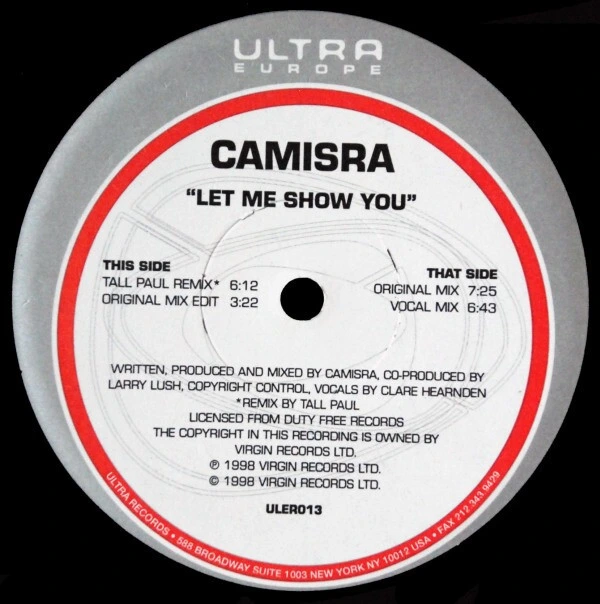
From Tall Paul's 1998 hard house cut, built in a matter of hours for a single gig, to Armin van Buuren's 2024 rework: the story of a record that refused to stay in the past.
Some records are designed to become hits. Others are made for one night, one crowd and one very specific moment, with no guarantee that anyone will ever hear them again. Camisra's Let Me Show You belongs firmly to the second category. Created for a BBC Radio 1 weekend at Amnesia Ibiza, it went on to reach the UK Top 5, became a long-running favourite in DJ sets, and in August 2024 returned with a fresh coat of paint thanks to Armin van Buuren.
What makes its story so compelling is not only the success it achieved, but the way it got there. There was no elaborate plan, no radio-friendly blueprint and no obvious formula. There was a DJ who knew exactly what a packed room wanted, a sampler, a bassline that people already loved, and a few hours in a studio.
In This Sound Breakdown:
- The man behind Camisra: Tall Paul and the Turnmills years
- The origins: a track made for one night at Amnesia
- Inside the production: Sandy B, the AKAI and an unconventional structure
- 1998: from the dancefloor to the UK charts
- Armin van Buuren's rework: a revival, not a reinvention
- Why Let Me Show You still works
The Man Behind Camisra: Tall Paul and the Turnmills Years
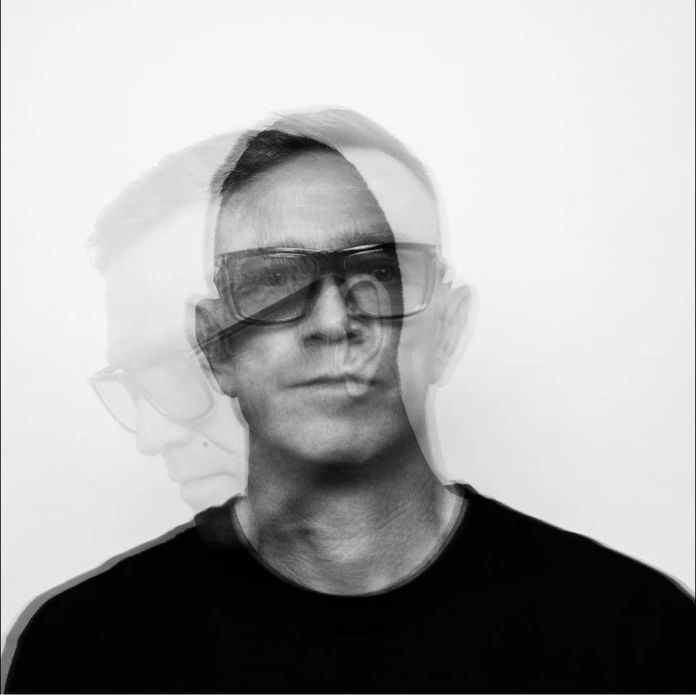
Behind the Camisra alias is “Tall” Paul Newman, an English DJ, producer and remixer born in 1971. His story is deeply tied to London's club scene: according to a profile on DJ Shy 90, he began DJing in 1985 at Turnmills, a nightclub owned by his father. That is a remarkably early start, and it gave him something many producers of his era did not have: years of first-hand experience reading a dancefloor before he ever released a record.
From there, he became a resident at several of the most important UK club nights of the 1990s, including Zap in Brighton and Trade in London, as noted in the DJ Mag series featured by Sonicstate. He also built a name as a producer and remixer, with Rock da House and his remix of INXS's Never Tear Us Apart, released as Precious Heart, among his best-known work. In 1998 he also set up Duty Free Recordings, giving him a platform to support new artists.
Ibiza became another key chapter. His summer residencies on the island earned him recognition, including a “Best Overall Deejay” title at the 1999 Ibiza Awards, according to Encyclopedia.com. That connection to the White Isle is not a side detail. It is the reason Let Me Show You exists.

Made for One Night: The Origins of a Floor-Filler
As Paul explains in the DJ Mag series, Let Me Show You was made exclusively for a BBC Radio 1 weekend gig at Amnesia, Ibiza, in 1998. He built it in the studio attached to Turnmills, which means the track was born inside club culture rather than outside it.
The speed of the process is part of the legend. In an interview for Skiddle, Paul says the tune was made in six hours, while in a later conversation with 909originals it is described as having come together in a couple of hours. The exact number varies between accounts, but the message is consistent: this was a fast, instinctive piece of work, not a long studio project.
His motivation was equally practical. He had always loved the Sandy B remix but struggled to fit it into his sets, so he wanted a tougher version built around that bassline sound, the moment that made crowds react when it dropped. He played the finished track that night in Ibiza, and by his own account the room went wild.
That context explains a lot. This was not a record shaped by radio expectations. It was shaped by the dancefloor, by a DJ who knew exactly what a packed room needed and built it himself, just in time for the gig.
Inside the Production: Sandy B, the AKAI and an Unusual Structure
The workflow was typical of the era. Paul ran a series of samples through his AKAI sampler, and the most prominent of them was Sandy B's “Make The World Go Round”. That track dates back to 1996, so the source material was relatively recent at the time, a club favourite that Paul reshaped into something harder and more direct.
Sonicstate notes that the record has an odd concoction of elements and structure, proof that there is no exact formula for making a hit. It doesn't follow the most predictable path, and that is precisely part of its identity. In an age where many dance productions are polished to fit a template, Let Me Show You sounds like what it was: a DJ's tool, assembled quickly and tested immediately on a real crowd.
Two elements keep coming back in every account of the record:
- The drums: kinetic, driving and constantly in motion, giving the track its physical energy.
- The synths: bold and rounded, with the slightly wonky chords that made the track a sound of summer and of Ibiza.
Together with the bassline at the heart of the sample, these elements create a record that works on instinct. It doesn't need complexity because its strength lies in impact: the drop, the movement, the way the whole room reacts at once.
Sonicstate describes it as a hard house record, a useful reminder of where it comes from. This was a world of resident DJs, long nights and tough, high-energy club sounds, far from the polished idea of a chart single. That a record from this scene could break into the mainstream says a lot about how strong its hook really was.
1998: From the Club to the Charts
Despite its underground roots, the track crossed over. According to the Official Charts Company, Let Me Show You entered the chart in February 1998, peaked at No. 5 on the Official Singles Chart and spent nine weeks on the listing. On the Official Dance Singles Chart it did even better: No. 1, with eleven weeks on the chart.
It also travelled beyond the UK. Chart data compiled on Wikipedia shows entries in Ireland (No. 19), the Netherlands (No. 53), Australia (No. 95) and France (No. 98), confirming that the track reached international audiences even if its real stronghold was Britain.
Camisra's follow-ups, Feel the Beat (No. 32) and Clap Your Hands (No. 34), kept the name alive, but Let Me Show You remains his only UK Top 10 hit, and the highest chart entry of Paul's career, as noted by Amsterdam Dance Event.
Paul also tells the story of the Top of the Pops appearance that never happened, a reminder of how close the track came to an even bigger moment. It's an anecdote best heard directly from him in the original DJ Mag video.
Armin van Buuren's Rework: A Revival, Not a Reinvention
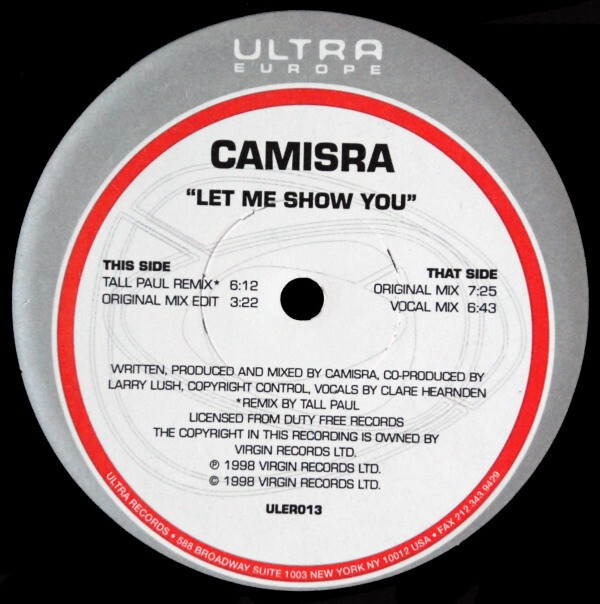
On 23 August 2024, the track returned on Armada Music as Camisra & Armin van Buuren. As reported by DJ Mag and Beatportal, the new version had already been tested at Tomorrowland Winter, a good indicator of how it would perform in a festival setting.
Armin's approach was clear from the start. His own explanation was that the original has so much character that he simply wanted to enhance what was already there. The goal was a revival rather than a reinvention. He keeps the driving drums and bold synths that defined the original, then adds his own signatures: deeper basslines and a more dramatic drop.
It is a smart decision. When a record carries this much nostalgia, a radical rebuild risks alienating the people who love it. Armin's version starts from what already worked and adapts it to the scale of today's mainstage sound. A review published on a trance blog describes the result as a 132 BPM mainstage banger built around the same wonky synth chords, though that figure comes from a reviewer rather than an official source.
The timing also helped. By 2024 the original had never really left the scene. As DJ Mag points out, it had remained a staple in sets by names such as James Hype, Jax Jones and Solomun. That continuous life in the booth meant the remix did not need to introduce the track to a new audience from scratch. It only needed to give them a version built for the present.
Why Let Me Show You Still Works
The answer lies in its origins. This was a record made for one specific room, by someone who lived that room every week, and that gives it an urgency that many more calculated productions lack. There was no attempt to fit a trend, only a clear idea: take a bassline that makes crowds react and make it tougher.
The 2024 rework proves the idea survives a modern makeover. The bass gets deeper and the drop gets bigger, but the identity stays intact: relentless drums, unmistakable synths and a rush of pure summer energy. It also shows how contemporary dance music keeps returning to its own archive, not out of nostalgia alone, but because certain records were built with such clarity that they can be reshaped without losing their core.
It is, in many ways, the opposite of a record built by formula, and that may be exactly why it still works more than a quarter of a century later.
One sampler, one bassline, one night in Ibiza and a very simple idea: Camisra built a classic in a matter of hours, and Armin van Buuren gave it a second life without betraying what made it special.