Starbucks does not treat music as simple background sound. Through its official Spotify profile, in-store playlists and dedicated Starbucks Music platform, the brand has turned coffeehouse music into part of its identity. This article explores how Starbucks uses playlist curation to shape atmosphere, customer experience and emotional connection.
In this post:
- Coffee loves music
- The official Starbucks Spotify profile
- Coffeehouse music as brand identity
- Why in-store playlists matter
- Playlist curation as customer experience
- What curators can learn from Starbucks
- Final Conclusion
Some cafés play music.
Starbucks builds atmosphere with it.
For Starbucks, music is not simply a sound placed in the background while people order coffee. It is part of the emotional architecture of the brand. The lighting, the smell of coffee, the design of the store, the seasonal cups, the barista experience and the music all work together to create a recognizable environment.
This is why Starbucks is such an interesting case for playlist curation.
The brand has understood that music can make a space feel warmer, more personal and more memorable. A customer might not remember every song playing in the background, but they remember the feeling of sitting inside the store with a drink, a laptop, a friend or a quiet moment alone.
That feeling is where playlist curation becomes branding.
Coffee loves music
On its official music page, Starbucks uses the phrase “Coffee Loves Music” and explains that music has played an essential role in the Starbucks experience for more than 40 years.
That statement is important because it shows that Starbucks does not treat music as an afterthought.
The company says it handpicks the artists and songs played around the world, and also points customers toward its playlists on Spotify. This means the playlist is not only something heard inside the store. It becomes something customers can take with them outside the store as well.
From a curation perspective, this is powerful.
The Starbucks experience does not end when someone leaves the café.
It continues through music.
The official Starbucks Spotify profile
Starbucks also has an official Spotify profile with public playlists connected to its brand world.
This is where the strategy becomes especially interesting. The playlists are not random collections of popular songs. They are organized around moods, cultural moments, store experiences and coffeehouse identity.
A playlist like Coffeehouse Pop immediately communicates a clear atmosphere: accessible, warm, melodic and easy to listen to while working, relaxing or drinking coffee.
A playlist like Starbucks Global Blend suggests something wider: an international sound connected to discovery, travel and cultural variety.
This matters because Starbucks is not only curating songs.
It is curating situations.
The playlist tells the listener when and how the music should be experienced: during a coffee break, while working, while relaxing, while discovering new artists or while recreating the Starbucks atmosphere at home.
Coffeehouse music as brand identity
A Starbucks playlist has a very specific job.
It must be present, but not intrusive.
It has to create a mood without taking over the room. It should support conversation, reading, studying, working and relaxing. This is very different from a club playlist or a festival playlist.
A festival playlist needs peaks.
A coffeehouse playlist needs flow.
The sound must feel smooth, warm and consistent. It should make the space feel alive without making it chaotic. It should help customers stay longer without feeling overwhelmed.
That balance is difficult.
If the music is too quiet or generic, the store feels flat.
If it is too loud or intense, the customer experience becomes stressful.
The best coffeehouse playlists live in the middle: interesting enough to notice, soft enough to support the moment.
Why in-store playlists matter
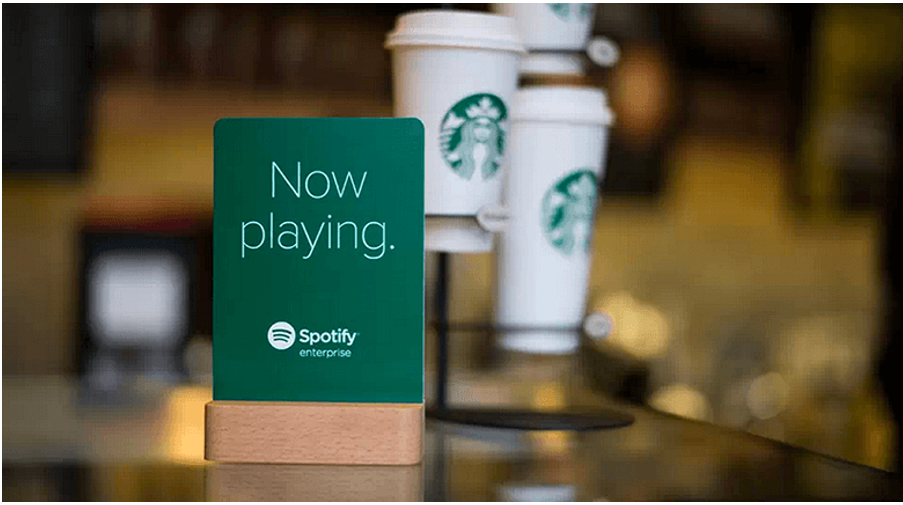
In-store music matters because it changes the emotional perception of the space.
The same coffee can feel different depending on the soundtrack around it. A warm acoustic track can make the store feel intimate. A soft pop song can make it feel friendly. A global soul or jazz-inspired selection can make it feel more cultured and relaxed.
This is why music is part of the customer journey.
The playlist helps define what Starbucks feels like.
It also creates consistency. A customer can enter a Starbucks in one city and feel a similar emotional atmosphere in another. The playlist becomes part of that recognizable identity.
For a global brand, this is extremely valuable.
Music becomes a way to make different stores feel connected.
Playlist curation as customer experience
The smartest part of Starbucks’ music strategy is that it connects the physical store with the digital platform.
When customers can find Starbucks playlists on Spotify, the brand experience becomes portable. The listener can bring the coffeehouse mood into their home, office, car or study session.
This is playlist curation as customer experience.
The playlist is not only promoting the brand.
It is useful.
It gives people a soundtrack for real life moments: working, relaxing, drinking coffee, reading or starting the morning.
This is similar to the logic behind the Barilla Playlist Timer, but with a different function. Barilla uses music to measure time. Starbucks uses music to recreate atmosphere.
Both examples show how playlist curation becomes stronger when it is connected to a real behavior.
What curators can learn from Starbucks
There are several lessons playlist curators can learn from Starbucks.
First, a playlist should have a clear context. Starbucks playlists are not abstract. They are connected to coffee, comfort, work, discovery and everyday rituals.
Second, flow matters more than shock value. A coffeehouse playlist should not be built only around big moments. It needs consistency.
Third, music can extend a brand beyond its physical space. When someone listens to a Starbucks playlist at home, they are still interacting with the brand emotionally.
Fourth, good curation does not need to be loud to be effective. Sometimes the most powerful playlists are the ones that support a moment quietly.
That is what Starbucks does well.
It uses music to shape experience without making the music feel forced.
Final Conclusion
Starbucks proves that playlists can be much more than background music.
They can become part of a brand’s identity, a customer’s routine and a portable version of a physical experience.
Through its official Spotify profile and Starbucks Music platform, the company turns coffeehouse sound into emotional branding. The playlist becomes a bridge between the store and the listener’s daily life.
For playlist curators, this is a masterclass in atmosphere.
The goal is not only to select good songs.
The goal is to design a feeling people want to return to.